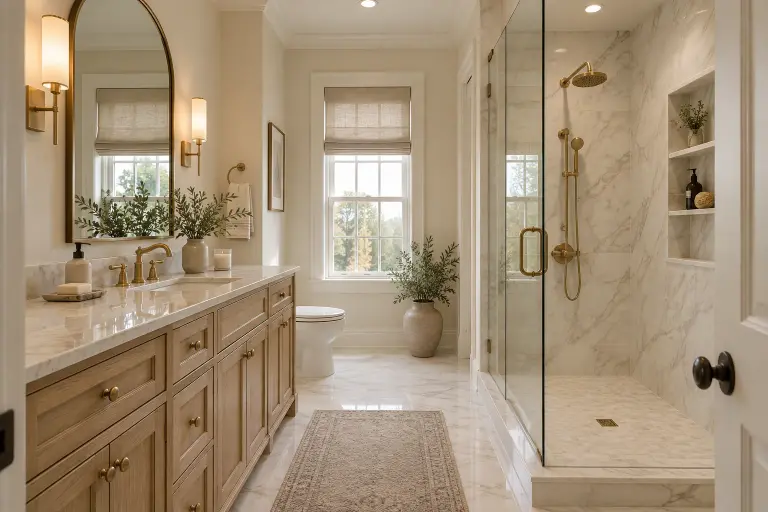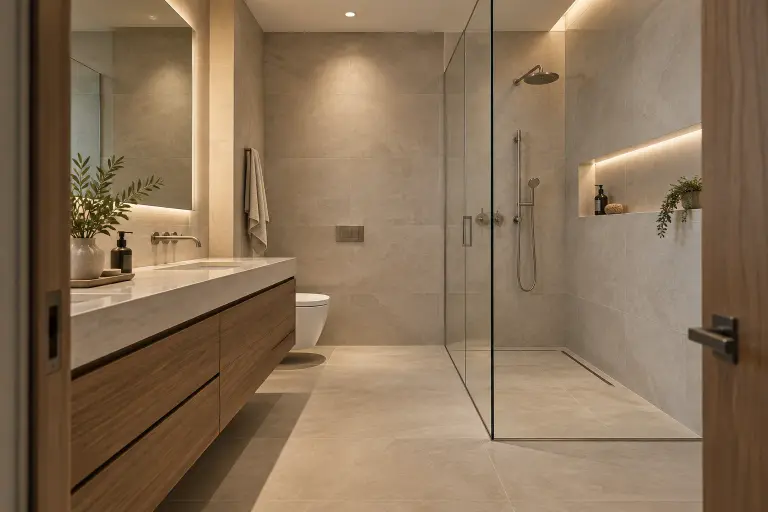
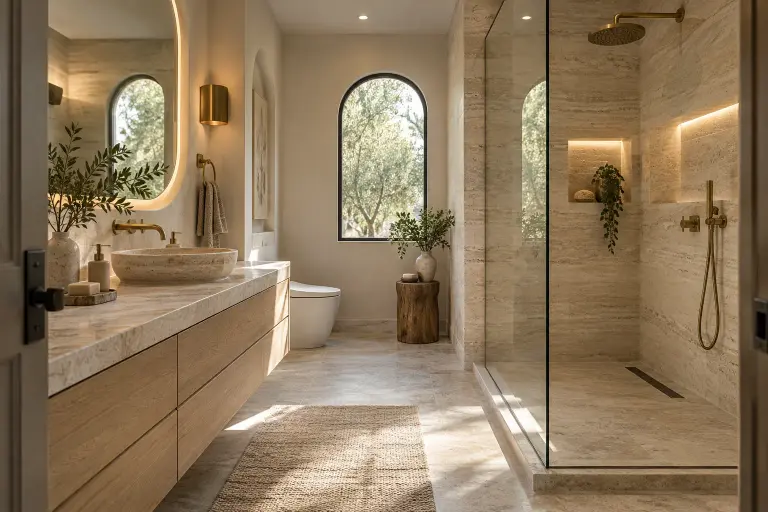
Warm bathrooms do not have to be beige from floor to ceiling. Their appeal comes from relationships: a wood-toned vanity against quiet tile, a soft wall color beside a mineral-looking countertop, or brushed hardware that adds definition. An organic bathroom feels composed because its textures and undertones support one another. The details should still suit your cleaning habits and the way you use the room.
What to take away
- Build the palette around one leading material.
- Evaluate texture for cleaning as well as appearance.
- Compare fixture finishes and paint samples together.
Why this look belongs in the conversation
NKBA’s 2026 research identifies interest in timeless and organic styles, light neutrals, and wood-faced vanities. That supports the relevance of a warm palette, but it does not mean every homeowner should choose the same room.
Use the direction as a starting point. A softly traditional house may suit framed cabinetry and a familiar tile pattern. A minimal interior may benefit from quieter cabinet fronts and fewer visual transitions. The bathroom should feel connected to the home around it, rather than look like an unrelated display.
Research reference: NKBA: 2026 Bath Trends Report ↗
Choose an anchor and edit around it
Begin with the material that occupies the largest visual area or matters most to you. If that is a warm stone-look shower tile, use it to judge the cabinet, countertop, and wall paint. If the vanity is the main feature, let its wood tone lead the discussion.
Keep statement surfaces from competing accidentally. A strongly veined countertop beside patterned shower tile can work, but requires balance. Bring samples together and decide which surface should lead when you enter the room.
Use texture where it gives something back
A textured accent can create depth in a niche, behind the vanity, or on a limited wall. Ask whether it belongs in an area that gets frequent splashing and how it will be cleaned. What looks subtle in a showroom can become visually busy across a large surface.
Compare the material in ordinary light as well as display lighting. Look at its edges and several pieces, and ask about variation. A sample should help you understand the actual product, not act as a perfect picture of every tile.
Let the metals add definition
Brushed nickel can create a restrained outline; a warm brushed finish can echo the cabinet and tile palette. Black can introduce contrast when repeated thoughtfully. These are design options, not rules about which finish belongs in an organic bathroom.
Check how the fixture finish relates to glass hardware, cabinet pulls, mirrors, and tile trim. Similar finish names from different product lines may not look identical. Decide where close matching matters and where a coordinated difference feels intentional. Compare the actual samples before ordering.
Finish with paint and useful storage
Test wall color beside the tile and countertop in the room’s lighting. Choose paint for the location as well as color. Benjamin Moore identifies Aura Bath & Spa as intended for high-humidity bathrooms; preparation and the chosen coating still need to suit the actual surface.
A calm palette also needs a place for clutter. Plan drawer interiors, towel storage, and shower shelves before finalizing cabinetry. Our Organic Spa and Japandi concepts can help describe the atmosphere; physical samples establish the final choices.
Research reference: Benjamin Moore: Aura Bath & Spa ↗
Bring the material palette into your home
For a custom bathroom in Mendham, Bernardsville, or Chester, compare tile and vanity samples in the room rather than choosing from a screen alone. Consider the light, neighboring finishes, and the amount of visible wood grain together. Our design team can coordinate Wayne Tile options, custom cabinets and countertops, Moen fixtures, and Benjamin Moore paint around the palette you approve.
Explore service details for Mendham, NJ, Bernardsville, NJ, Chester, NJ. Coverage is confirmed for the property within our 55-mile straight-line radius of Milford, PA.
Sources and further reading
This homeowner planning guide is general information. Actual product requirements, existing conditions, installation methods, and project scope must be reviewed for your bathroom.
Plan the bathroom around your home.
We serve eligible homes within 55 miles of Milford, PA, across PA, northern NJ, and NY. Request an in-home consultation to discuss your layout, materials, priorities, and investment range. Your preferred visit window requires team approval.
Check your community →